




4J Studios has unveiled Rixels, a texture technology the Dundee-based developer says produces sharper results than conventional textures at a fraction of the memory cost. The studio has applied to patent it, GamesIndustry.biz reports.
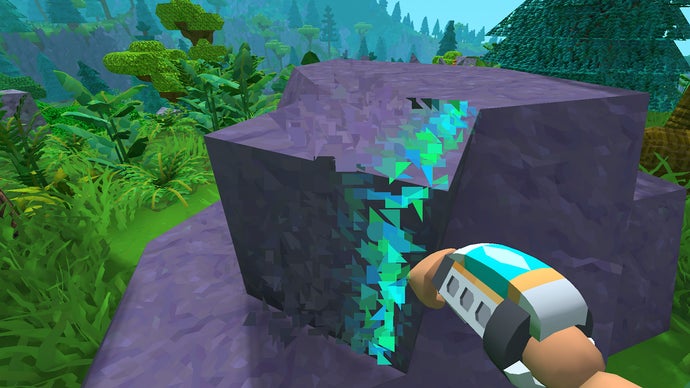
Short for Reforj Pixels, a Rixel is a modified pixel that contains one of 23 vector shapes. Because vector graphics are built from mathematical formulas rather than a fixed grid of coloured squares, they hold their sharpness at any render size, so a Rixel-based texture does not blur as the camera moves closer.
The Rixel was our response to a problem with texture size. We were using 512x512 normal textures, so a pixel grid with square pixels in it, but as [the game] got bigger and bigger and bigger, we realised that we were going to run ourselves into a wall with space.
Van der Kuyl set the problem to chief technology officer Richard Reavy, who designed the format. The figures 4J gives are stark. A 512x512 pixel grid in the studio's Minecraft-like sandbox game Reforj previously required 4MB of memory; the same grid built from 20x20 Rixel squares needs 72KB, a reduction of more than 98%.
The saved memory is what lets Reforj hold its frame rate, according to van der Kuyl, who framed a stable 60fps as the design target that prompted the work in the first place.
Generally, when you get these block building games, or voxel-based games, they start to get performance restrictive quite early. So we asked ourselves, could we build an engine that gave you persistent 60-frames-per-second in this kind of game? It may be a geeky thing to say, but for a player it would transform their experience.
Rixels sit inside 4J's proprietary Elements Engine, which creative director Brian Gomez has said the studio built so it could make its own sandbox games after years spent porting Minecraft to consoles and handhelds. Van der Kuyl said he was surprised nobody had arrived at the approach earlier, calling it deceptively simple and saying the team had assumed somebody must already have done it.
4J is open to licensing the technology outside its own games, with van der Kuyl citing graphic design tools as one possibility, while acknowledging it may matter less to photorealistic titles than to stylised ones.